
Is Your Child Really the Problem—or Is the School Environment Making Them Look Like One?

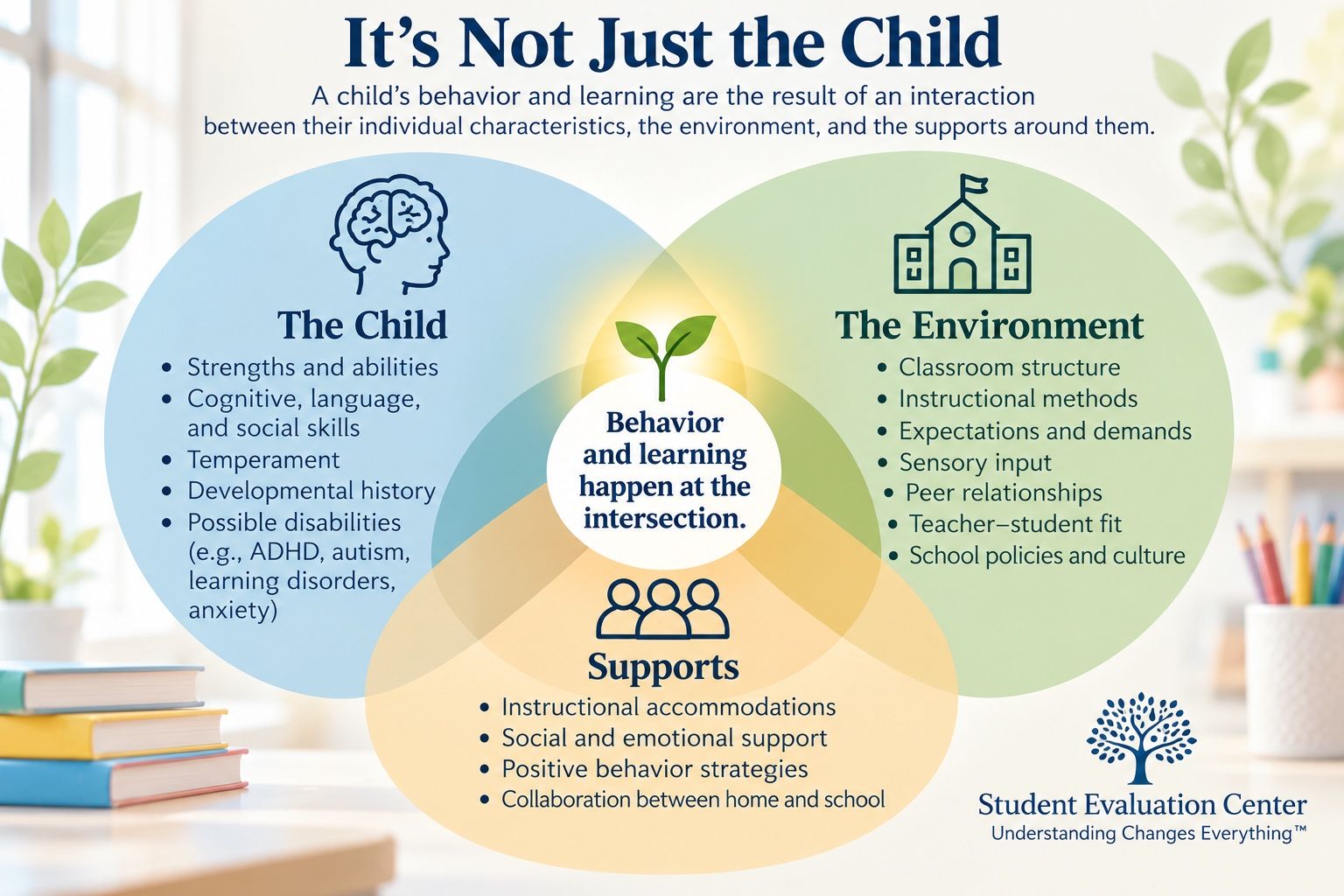
When children struggle with behavior, attention, anxiety, or learning at school, we often focus on what needs to change about the child. But what if we're overlooking an equally important question: What needs to change about the environment?
When parents hear that their child is having behavior problems at school, the conversation often focuses on what the child is doing wrong. But sometimes we need to look more closely at the classroom environment, academic expectations, and other factors that may be contributing to those difficulties.
Imagine two children.
The first is an energetic eight-year-old who has difficulty sitting still, frequently interrupts, and struggles to complete independent assignments. His teacher describes him as impulsive, disruptive, and constantly off task.
The second is a quiet ten-year-old who rarely participates in classroom discussions, frequently asks to visit the nurse, and sometimes cries before school. Her teacher describes her as anxious, withdrawn, and reluctant to participate.
Both children may eventually be referred for psychological evaluations.
But before we begin asking what might be wrong with either child, shouldn't we also ask what is happening around them?
Perhaps the eight-year-old spends much of his school day sitting through lengthy instructional periods with limited opportunities for movement. Perhaps the ten-year-old is struggling with peer rejection, academic expectations she finds overwhelming, or a classroom where she feels uncomfortable making mistakes.
These possibilities do not mean either child has been misidentified or that a disability is absent. Both may have legitimate developmental, emotional, or behavioral needs.
But if we evaluate only the child without examining the environment, we may be missing an important part of the explanation.
And that can lead us toward interventions that address the symptoms without adequately addressing what contributes to them.
We Have Become Very Good at Identifying Problems in Children
Schools routinely identify concerns involving attention, emotional regulation, behavior, learning, and social functioning.
A student who cannot remain seated may be referred for an ADHD evaluation. A child who refuses to attend school may be evaluated for anxiety. A student who argues with adults or refuses assignments may be described as oppositional.
Sometimes these concerns reflect genuine psychological or developmental disorders. Identifying those conditions can be enormously helpful, especially when it leads to appropriate support.
However, there is a potential problem when our attention becomes focused almost exclusively on the characteristics of the child.
We begin asking questions such as:
Why can't this child pay attention?
Why does this child become so upset?
Why won't this student follow directions?
Why does this child refuse to complete assignments?
What diagnosis might explain these behaviors?
Those are reasonable questions.
But they are not the only questions we should be asking.
We should also be asking:
Are classroom expectations appropriate for this child's developmental level?
Does the child understand the material being taught?
Are instructional methods compatible with the child's learning needs?
Is the child experiencing bullying, embarrassment, or social rejection?
Are sensory demands, transitions, or environmental distractions contributing to the difficulty?
Does the child have opportunities to experience success, connection, and belonging?
Sometimes the most useful information comes not from asking why a child is struggling, but from asking when, where, and under what circumstances the struggle occurs.
The Same Child Can Look Very Different in Different Environments
Consider a child who struggles to remain seated during a 40-minute classroom lesson but can spend an hour carefully building a complicated LEGO structure.
Or a student who rarely speaks in class but communicates comfortably with familiar adults and friends.
Perhaps a child demonstrates significant behavioral difficulties with one teacher but relatively few difficulties with another.
These differences are worth examining.
They may reflect variations in instructional demands, adult-child relationships, predictability, classroom structure, anxiety, motivation, or the child's ability to manage particular situations.
However, we need to be careful about the conclusions we draw.
A child who can concentrate on an enjoyable activity may still have ADHD. A child who speaks comfortably at home may still experience clinically significant anxiety. A student who behaves differently across classrooms may have a genuine disability that becomes more apparent under certain demands.
Different behavior across environments does not prove that a disability is absent. It tells us that the environment may be influencing how the child's difficulties are expressed.
That distinction is extremely important.
A comprehensive evaluation should consider both the child's underlying characteristics and the circumstances in which difficulties become more or less apparent.
What Does the Research Tell Us About School Environments?
Research supports the idea that school environments play an important role in children's emotional well-being, behavior, and academic functioning.
The Centers for Disease Control and Prevention (CDC) identifies school connectedness—the feeling that adults and peers at school care about students and their learning—as an important protective factor.
Students who feel connected to their schools are more likely to demonstrate positive academic outcomes and less likely to experience certain mental health and behavioral difficulties.
The CDC also emphasizes the importance of safe, supportive school environments that promote positive relationships, clear expectations, and student engagement.
This does not establish that an unsupportive school environment causes a particular psychological disorder. Nor does it mean that improving school climate will eliminate ADHD, autism, anxiety disorders, or learning disabilities.
It does suggest that the environment deserves serious attention when we are trying to understand why a student is struggling.
A child who feels safe, supported, and understood may function differently from the same child in an environment that produces persistent stress, confusion, or frustration.
The environment may not be the origin of a child's difficulties, but it can influence their frequency, intensity, and impact.
When Developmentally Normal Behavior Becomes a School Problem

Here is a question worth considering:
Are we sometimes expecting children to demonstrate levels of attention, independence, emotional control, or behavioral restraint that exceed their developmental readiness?
Children do not develop these abilities at identical rates.
Executive functioning skills—including planning, organization, impulse control, working memory, and emotional regulation—continue developing throughout childhood and adolescence.
A six-year-old who struggles to remain seated, a nine-year-old who forgets assignments, or a middle school student who has difficulty organizing multiple classes is not automatically demonstrating evidence of a disorder.
The concern becomes more significant when the difficulties are developmentally unusual, persistent, and interfere meaningfully with everyday functioning.
But the demands being placed on the child also matter.
For example, a young student who struggles during extended periods of independent seatwork may demonstrate better engagement when instruction includes shorter activities, movement, feedback, and opportunities for active participation.
That improvement does not necessarily mean the child never had an attention problem.
It may mean the instructional environment is providing the structure needed for the child to function more successfully.
There is an important difference between helping children develop necessary skills and expecting them to demonstrate skills they have not yet developed.
Good educational practice recognizes that difference.
Sometimes Behavior Is a Response to Something We Have Not Identified
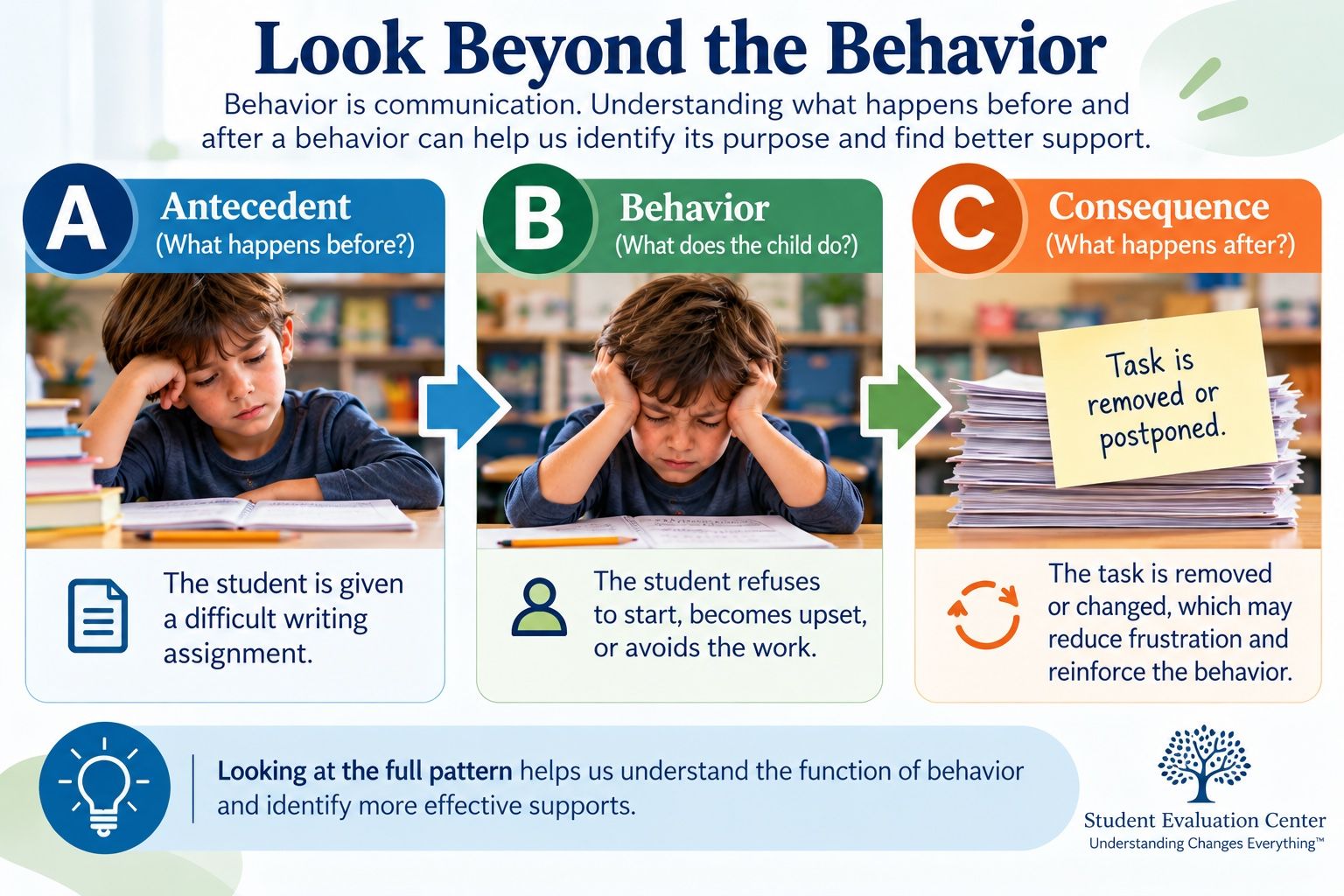
Consider a student who frequently refuses to begin written assignments.
Adults may interpret the behavior as defiance, laziness, or a lack of motivation.
But what if the child has significant difficulty organizing thoughts, spelling words, or producing written language?
What looks like refusal may actually be avoidance of an activity the child finds extremely difficult.
Now consider a student who becomes angry when asked to read aloud.
The immediate concern may be the emotional outburst. Yet the underlying issue could involve a reading disability, fear of embarrassment, or repeated experiences of failure.
Another child may become disruptive during unstructured activities because navigating peer interactions is unusually difficult.
In each situation, the observable behavior is real. It may interfere with learning and require intervention.
But focusing exclusively on stopping the behavior may not address why it occurs.
This is one reason functional behavioral assessment can be valuable.
Rather than simply labeling a behavior as inappropriate, a functional behavioral assessment examines the circumstances surrounding it, including what happens before the behavior, what follows it, and what purpose the behavior may serve.
The goal is to develop a better understanding of the behavior so that interventions can address the student's needs more effectively.
For students receiving special education services, the Individuals with Disabilities Education Act (IDEA) requires IEP teams to consider positive behavioral interventions and supports, along with other strategies, when a child's behavior interferes with learning.
That requirement reflects an important principle: Supporting behavior involves more than telling children what not to do.
What About ADHD, Autism, Anxiety, and Other Disabilities?
This is where the discussion requires balance.
It would be a mistake to suggest that children's psychological or developmental difficulties are simply products of inappropriate school expectations.
ADHD is a recognized neurodevelopmental disorder. Autism involves developmental differences that cannot be explained solely by classroom conditions. Anxiety disorders and learning disabilities are also genuine conditions that may require specialized intervention.
A child does not stop having ADHD because a teacher provides effective classroom structure. An autistic student does not stop being autistic because sensory demands are reduced. A child with dyslexia does not stop having a reading disability because instruction becomes more appropriate.
However, these changes may substantially improve the child's ability to function.
In fact, a supportive environment may be especially important for children with disabilities.
The American Academy of Pediatrics' clinical practice guideline for ADHD emphasizes gathering information from multiple sources and documenting symptoms and impairment across more than one major setting. It also recognizes the school environment as an important part of treatment planning.
This matters because a diagnosis should not be based solely on a child's behavior during one class, with one teacher, or under one particular set of circumstances.
At the same time, difficulties that occur primarily at school should not automatically be dismissed.
A child may face demands at school that are rarely encountered at home. Those demands may reveal genuine weaknesses that are less noticeable elsewhere.
The purpose of a good evaluation is not to prove that the child has a disability or to prove that the school is responsible. It is to understand what is happening and why.
When the Classroom Environment Makes an Existing Difficulty Worse
Imagine a child with ADHD who struggles with sustained attention, organization, and impulse control.
In one classroom, the teacher provides clear instructions, predictable routines, movement opportunities, and frequent feedback. The student still has some difficulties, but generally participates successfully.
In another classroom, instructions are lengthy, expectations change frequently, and students are expected to manage several independent tasks without much structure.
The same child may experience significantly greater difficulty.
Or consider an autistic student who becomes overwhelmed in a noisy cafeteria but participates comfortably in a quieter lunch setting.
Neither example suggests that the disability is imaginary.
Instead, each illustrates the interaction between the child's characteristics and the demands of the environment.
In psychology, this is often understood through a person-environment fit perspective.
A child's functioning depends partly on how well their abilities, needs, and characteristics align with the expectations and supports of a particular setting.
When that fit is poor, difficulties may become more noticeable.
When the fit improves, functioning may improve as well.
This is not about removing every challenge from a child's life. Children need opportunities to develop independence, flexibility, persistence, and coping skills.
It is about ensuring that expectations are reasonable and that children receive the support necessary to meet them.

Could We Be Misinterpreting Some Children's Behavior?
Yes. And this possibility deserves thoughtful consideration.
A child who appears inattentive may be confused by the lesson.
A child who seems oppositional may be trying to avoid repeated academic failure.
A student who withdraws socially may be experiencing bullying or rejection.
A child who frequently complains of headaches or stomachaches may be experiencing anxiety related to school.
And a student who becomes emotionally overwhelmed may be responding to demands that exceed their current coping abilities.
Of course, these behaviors can have multiple explanations. They may reflect a disability, an environmental concern, a medical issue, or several contributing factors.
We cannot determine the cause simply by observing the behavior.
That is precisely why comprehensive assessment matters.
When we move too quickly from a behavior to a label, we risk overlooking information that could change how we understand and support the child.
Five Questions Parents Should Ask When Their Child Struggles at School
If your child is experiencing persistent behavioral, emotional, or learning difficulties, consider asking the school these questions.
1. When and where are the difficulties most noticeable?
Ask whether the problems occur throughout the day or primarily during certain subjects, activities, transitions, or interactions. Patterns may help identify contributing factors.
2. What happens immediately before the behavior?
Understanding what precedes a behavior can be just as important as understanding the behavior itself. Does it occur when work becomes difficult, during noisy activities, or following interactions with particular peers?
3. Are there situations in which my child is more successful?
Look for classes, activities, instructional approaches, or relationships associated with improved functioning. These can provide clues about supports that may be helpful elsewhere.
4. What changes have been attempted in the classroom, and what happened?
Ask about adjustments to instruction, expectations, seating, movement opportunities, behavioral supports, or task demands. It is useful to know which strategies have been tried and whether they made a difference.
5. Are we considering both my child's individual needs and the school environment?
A thorough assessment should examine relevant developmental, academic, emotional, behavioral, and environmental factors rather than relying on one explanation.
Parents should also remember that classroom interventions and environmental adjustments are not substitutes for an appropriate evaluation when a disability is suspected. Under IDEA, schools cannot use intervention procedures to unnecessarily delay or deny an evaluation.
This Is Not About Blaming Teachers
Teachers work in increasingly complex classrooms.
They are expected to address a wide range of academic, developmental, emotional, and behavioral needs, often while managing large groups of students and limited resources.
Many teachers recognize that a child's difficulties are influenced by classroom demands and work hard to adjust their approaches accordingly.
The purpose of this discussion is not to suggest that teachers are creating children's disabilities or that schools are responsible for every behavioral difficulty.
Nor should parents assume that a challenging classroom experience automatically means a teacher is doing something wrong.
Sometimes a child has significant needs despite excellent teaching and a supportive environment.
Sometimes a classroom needs adjustments that are difficult to provide without additional resources or support.
And sometimes both the child and the environment need attention.
The goal should not be to assign blame. It should be to develop the most accurate understanding possible so that we can provide the right kind of help.
What a Comprehensive Psychological Evaluation Should Consider
A meaningful psychological or psychoeducational evaluation involves more than administering standardized tests and reviewing rating scales.
Depending on the referral concerns, it may include an examination of:
Developmental, medical, educational, and family history.
Cognitive abilities and academic achievement.
Attention, executive functioning, and self-regulation.
Emotional, behavioral, and social functioning.
Parent and teacher observations across different settings.
Classroom expectations, instructional demands, and environmental influences.
Patterns of strengths and weaknesses.
The relationship between observed difficulties and the child's everyday functioning.
Not every child requires every assessment measure. The evaluation should be individualized and guided by the questions being asked.
Most importantly, the findings should be integrated rather than interpreted in isolation.
A teacher rating scale indicating significant attention difficulties provides valuable information. But it does not, by itself, establish ADHD.
Likewise, a parent's report that the child behaves well at home does not automatically rule out a disability.
The evaluator must consider how the available information fits together, including differences between settings and possible explanations for those differences.
A strong evaluation should help answer not only what difficulties does this child have? but also what factors are contributing to those difficulties, and what might help?
The Question We Should Be Asking
When a child struggles at school, it is natural to focus on the child.
After all, the child is the one who is not completing assignments, becoming upset, avoiding school, or having difficulty following classroom expectations.
But focusing only on the child can give us an incomplete picture.
Sometimes the primary concern involves an underlying developmental, learning, or psychological disorder.
Sometimes the school environment is contributing significantly to the difficulty.
And often, the most accurate explanation involves an interaction between the two.
Children deserve to have their individual needs recognized. They also deserve learning environments that are responsive to those needs.
We should be willing to examine both.
Because the most important question is not whether the child or the school is the problem.
The most important question is: What is making school difficult for this child, and what can we do to make it better?
Frequently Asked Questions About Child Behavior at School
Can a school environment make ADHD symptoms worse?
Yes. Classroom distractions, instructional demands, limited opportunities for movement, and inconsistent routines can make it more difficult for children with ADHD to manage attention, activity levels, and impulse control. Supportive classroom practices, predictable expectations, and appropriate accommodations can help students function more successfully. However, ADHD is a neurodevelopmental disorder and is not caused by an unsupportive classroom environment.
Why does my child behave differently at school than at home?
Children encounter different expectations, social situations, academic demands, and sensory experiences at school than they do at home. A child who functions well in one environment may struggle in another. These differences do not necessarily indicate that a disability is present or absent. Instead, they provide important information about the circumstances that influence a child's behavior and emotional functioning.
Can a child have behavior problems at school without having a disability?
Absolutely. Behavioral difficulties can result from many factors, including developmental immaturity, academic frustration, peer conflicts, environmental demands, and temporary stressors. Not every behavioral concern indicates a psychological or developmental disorder. However, when difficulties are persistent, occur repeatedly, or significantly interfere with learning or everyday functioning, a more comprehensive evaluation may be appropriate.
About Student Evaluation Center
At Student Evaluation Center, we believe that understanding a child's difficulties requires looking beyond individual test scores or isolated behaviors. Comprehensive psychological and psychoeducational evaluations can help identify developmental, learning, attention, emotional, and behavioral needs while considering the circumstances that influence a child's functioning.
Our goal is to help families better understand their children and make informed decisions about appropriate educational and psychological support.
Understanding Changes Everything™
Visit www.studentevalcenter.com.
Research and Resources
Centers for Disease Control and Prevention (CDC). (2024). School Connectedness Helps Students Thrive. Explains the relationship between school connectedness, mental health, student engagement, and academic outcomes.
https://www.cdc.gov/youth-behavior/school-connectedness/index.html
Centers for Disease Control and Prevention (CDC). (2024). Safe and Supportive School Environments. Discusses the importance of positive relationships, predictable expectations, and supportive school environments.
https://www.cdc.gov/healthy-youth/what-works-in-schools/safe-supportive-school-environments.html
Wolraich, M. L., et al. (2019). Clinical Practice Guideline for the Diagnosis, Evaluation, and Treatment of Attention-Deficit/Hyperactivity Disorder in Children and Adolescents. Pediatrics, 144(4), e20192528.
https://doi.org/10.1542/peds.2019-2528
U.S. Department of Education. Individuals with Disabilities Education Act, 34 CFR § 300.324: Development, Review, and Revision of IEP. Addresses the consideration of positive behavioral interventions and supports when behavior interferes with learning.
https://sites.ed.gov/idea/regs/b/d/300.324
National Association of Independent Schools. (2026). Fostering Student Belonging: Frameworks, Challenges, and Strategies for Inclusive School Communities. A research advisory examining student belonging and school engagement.
Educational Disclaimer
This article is provided for educational and informational purposes only and is not intended to replace an individualized psychological evaluation, diagnosis, or professional consultation. Children's learning, behavior, and emotional functioning are influenced by many factors, and the information presented should not be interpreted as suggesting that school environments are responsible for all behavioral or academic difficulties. Every child and situation is unique. Parents who have concerns about their child's development, learning, or behavior are encouraged to consult with qualified professionals to determine whether further evaluation or support may be appropriate.
© 2026 Student Evaluation Center, LLC