
ADHD at Home but Not at School: Can Your Child Still Have ADHD?
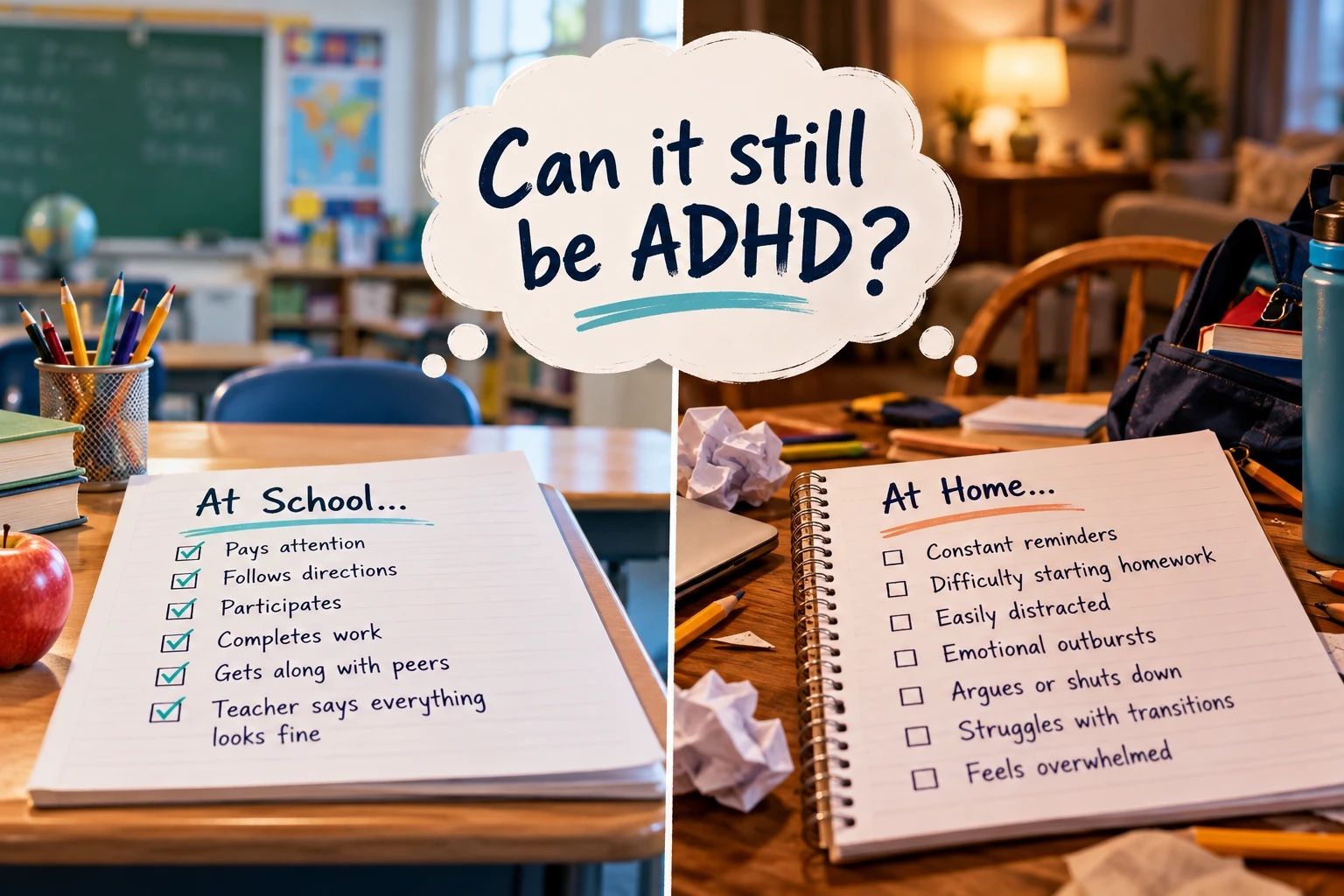
A parent sits down to complete an ADHD questionnaire and checks box after box.
Difficulty staying focused? Yes.
Needs constant reminders? Yes.
Loses things? Absolutely.
Homework takes forever? Yes.
Easily frustrated? Definitely.
Then the teacher completes the same type of questionnaire and the results come back looking completely different. The teacher reports that the child pays attention, follows directions, completes assignments, gets along with classmates, and generally does well in the classroom.
Now the parent is confused. Maybe even a little frustrated.
How can we possibly be talking about the same child?
This is something I see fairly often when evaluating children for ADHD. Parents sometimes worry that because the teacher does not see the same behaviors they see at home, their concerns will be dismissed. On the other hand, teachers may understandably wonder about ADHD when the child sitting in their classroom does not look like a child who is struggling with attention or impulse control.
The truth is that both the parent and the teacher may be accurately describing the child they see.
And that is exactly why evaluating ADHD can be more complicated than simply adding up the scores on a questionnaire.
Doesn't ADHD Have to Be Present in More Than One Setting?
Yes. This is an important point. For a diagnosis of ADHD, symptoms cannot occur exclusively in one situation. Current diagnostic criteria require several symptoms to be present in two or more settings, such as home, school, work, social situations, or other activities.
The American Academy of Pediatrics also recommends gathering information from parents, teachers, school personnel, and others who know the child when evaluating ADHD.
But there is an important distinction that sometimes gets lost:
Symptoms need to occur in more than one setting. They do not have to look exactly the same in every setting.
A child does not need to be bouncing out of the chair, failing assignments, forgetting everything, and interrupting everyone both at home and at school to have ADHD.
Children respond to their environments. And home and school can be very different environments.
Why Might a Child Look Fine at School?
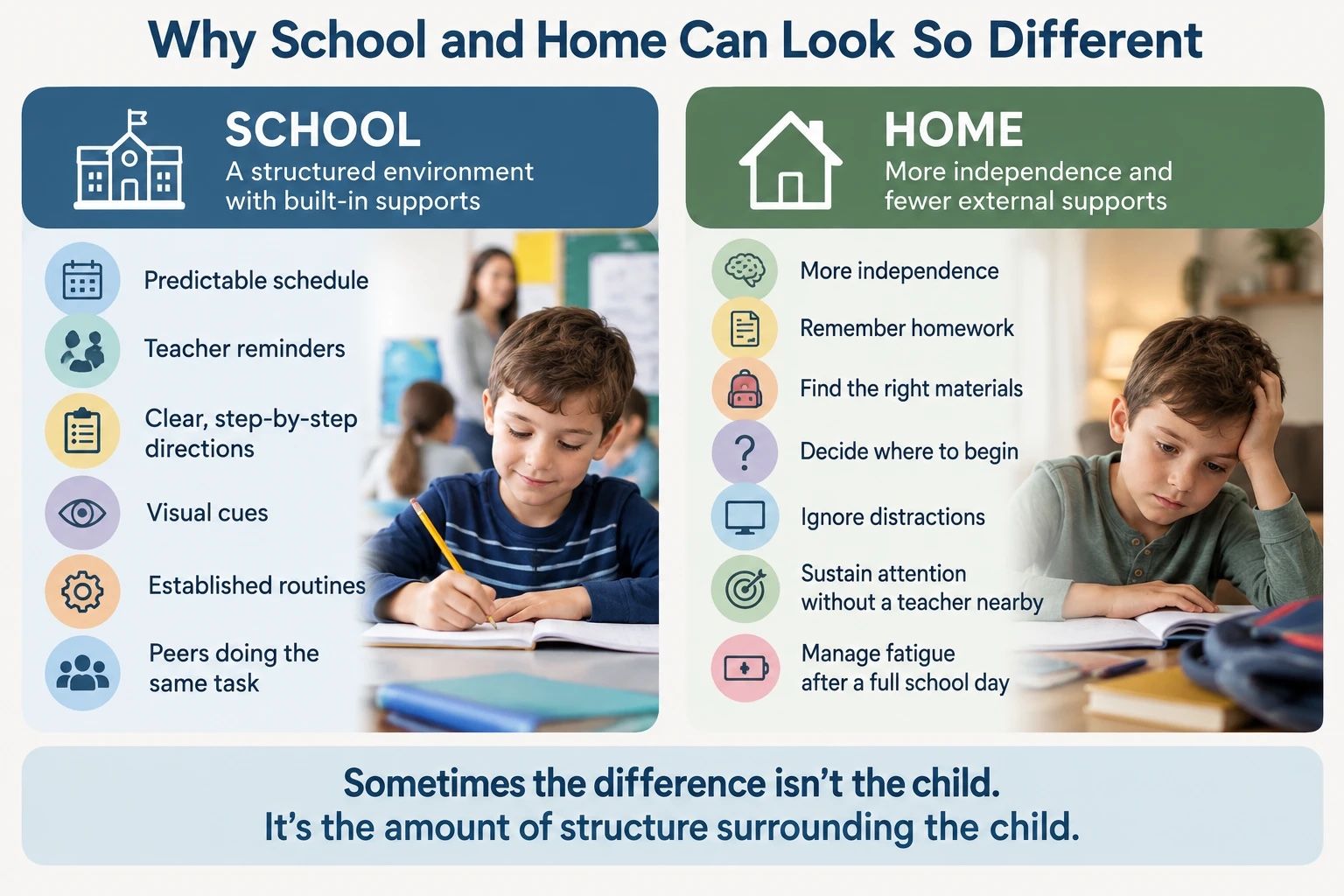
Think for a moment about the typical elementary school classroom. The day is structured. There is a schedule. The teacher tells students what to do and when to do it. There are visual reminders, bells, routines, expectations, consequences, and other children doing the same thing.
The teacher might say:
“Take out your math book.”
“Turn to page 42.”
“Complete problems one through ten.”
“Put your paper in the basket.”
For some children with attention or executive functioning weaknesses, all that external structure is enormously helpful.
Now think about what happens after school.
The child comes home tired. The backpack gets dropped by the door. Someone asks about homework. The child needs to find the assignment, remember what the teacher said, gather the right materials, decide where to start, ignore the television or younger sibling, keep working when the task becomes boring, and finish everything without a teacher standing nearby.
Suddenly, many of the supports that helped the child function throughout the school day are gone.
What looks like a completely different child may actually be the same child responding to a completely different set of demands.
Some Children Work Very Hard to Hold It Together at School
There is another possibility that parents frequently describe.
Their child seems to use an enormous amount of energy getting through the school day.
The child follows the rules. They try hard. They may worry about disappointing the teacher or getting into trouble. They watch what the other students are doing and follow along. Some children develop strategies that help compensate for their difficulties.
Then they get home. And everything falls apart.
Parents may describe crying, arguing, irritability, refusal to start homework, emotional outbursts, or what seems like complete exhaustion.

This does not automatically mean ADHD. Anxiety, learning difficulties, sleep problems, stress, autism, mood concerns, and other factors can produce similar patterns. That is one reason a good evaluation should look beyond ADHD rather than beginning with the assumption that ADHD must be the answer.
But a child behaving well at school does not, by itself, settle the question either.
Good Grades Don't Necessarily Rule Out ADHD
This is another misconception I hear regularly.
“My child gets good grades, so the teacher doesn't think it could be ADHD.”
Grades are certainly important information. But they are only one piece of information.
A bright child may compensate for attention weaknesses for years. Another child may earn A's and B's but spend two or three hours completing homework that should take 45 minutes. A student may understand the material extremely well but repeatedly forget to turn assignments in. Some children procrastinate until the last possible moment and then complete excellent work under tremendous stress.
The question isn't simply:
“Is this child getting good grades?”
We also want to know:
“What does it take for this child to get those grades?”
Those are very different questions.
What If the Parent and Teacher ADHD Ratings Don't Match?
This is where evaluation becomes especially important.
Parent and teacher rating scales are useful tools, but they are not diagnoses.
If a parent reports significant ADHD symptoms and a teacher reports very few, I don't think the appropriate response is to simply decide that one of them must be wrong.
Instead, the discrepancy itself becomes information.
Why are they seeing something different?
Maybe the classroom provides enough structure to compensate for the child's weaknesses.
Maybe the child struggles during certain classes but not others.
Maybe problems are more noticeable during independent work than during teacher-directed instruction.
Maybe homework places greater demands on executive functioning.
Maybe the child's difficulties become more apparent when medication is wearing off later in the day.
Or perhaps the home difficulties are being caused by something other than ADHD.
All of those possibilities deserve consideration.
Research has long shown that parents and teachers do not always rate ADHD behaviors the same way. That disagreement doesn't necessarily mean somebody isn't paying attention. They may genuinely be observing different behavior in different environments.
So Can a Child Have ADHD If the Teacher Doesn't See It?
Possibly. But this is where we need to be careful.
If ADHD symptoms truly occur only at home and nowhere else, that would raise questions about whether ADHD is the best explanation because ADHD requires symptoms across more than one setting.
However, “the teacher doesn't see ADHD” is not necessarily the same thing as “there are no ADHD symptoms outside the home.”
That distinction matters.
Perhaps the symptoms are subtle at school. Maybe they appear during sports, church, extracurricular activities, visits with relatives, homework, or interactions with friends. Maybe the child is compensating well enough that the difficulties don't immediately appear problematic to the teacher.
Or maybe careful evaluation reveals that ADHD really isn't the best explanation.
The goal should not be to prove that a child has ADHD.
The goal should be to understand why the child is struggling.
A Good ADHD Evaluation Should Look at the Whole Child
There is no single test that can diagnose ADHD.
A comprehensive evaluation typically considers developmental and medical history, parent concerns, teacher information, behavioral observations, rating scales, academic functioning, attention and executive functioning, and other areas depending on the concerns being reported.
It is also important to consider other explanations.
Anxiety can make concentrating difficult. A learning disability can make a child avoid homework. Poor sleep can affect attention and behavior. Autism may involve executive functioning and emotional regulation difficulties. Depression, family stress, language difficulties, and other conditions can sometimes look like ADHD.
Sometimes ADHD is present along with one or more of these concerns. That is why I am cautious about relying too heavily on any single questionnaire, test score, teacher report, or parent observation.
Each gives us a piece of the puzzle. The job of an evaluation is to put those pieces together.
Parents Know Their Child. Teachers Know Their Student.
I think this may be the most important point.
Parents and teachers sometimes feel as though their observations are competing with each other.
They shouldn't be.
A parent may know what happens during homework, bedtime, mornings, weekends, family activities, and those moments when the child is tired or frustrated.
A teacher sees the child in a structured learning environment, around peers, completing academic tasks, following group directions, and managing the expectations of a classroom.
Both perspectives are valuable.
When those perspectives disagree, we shouldn't automatically throw one of them away.
Sometimes the disagreement is exactly where we need to start asking better questions.
When Should You Consider an Evaluation?
If your child is functioning well at school and at home, there may be little reason for concern.
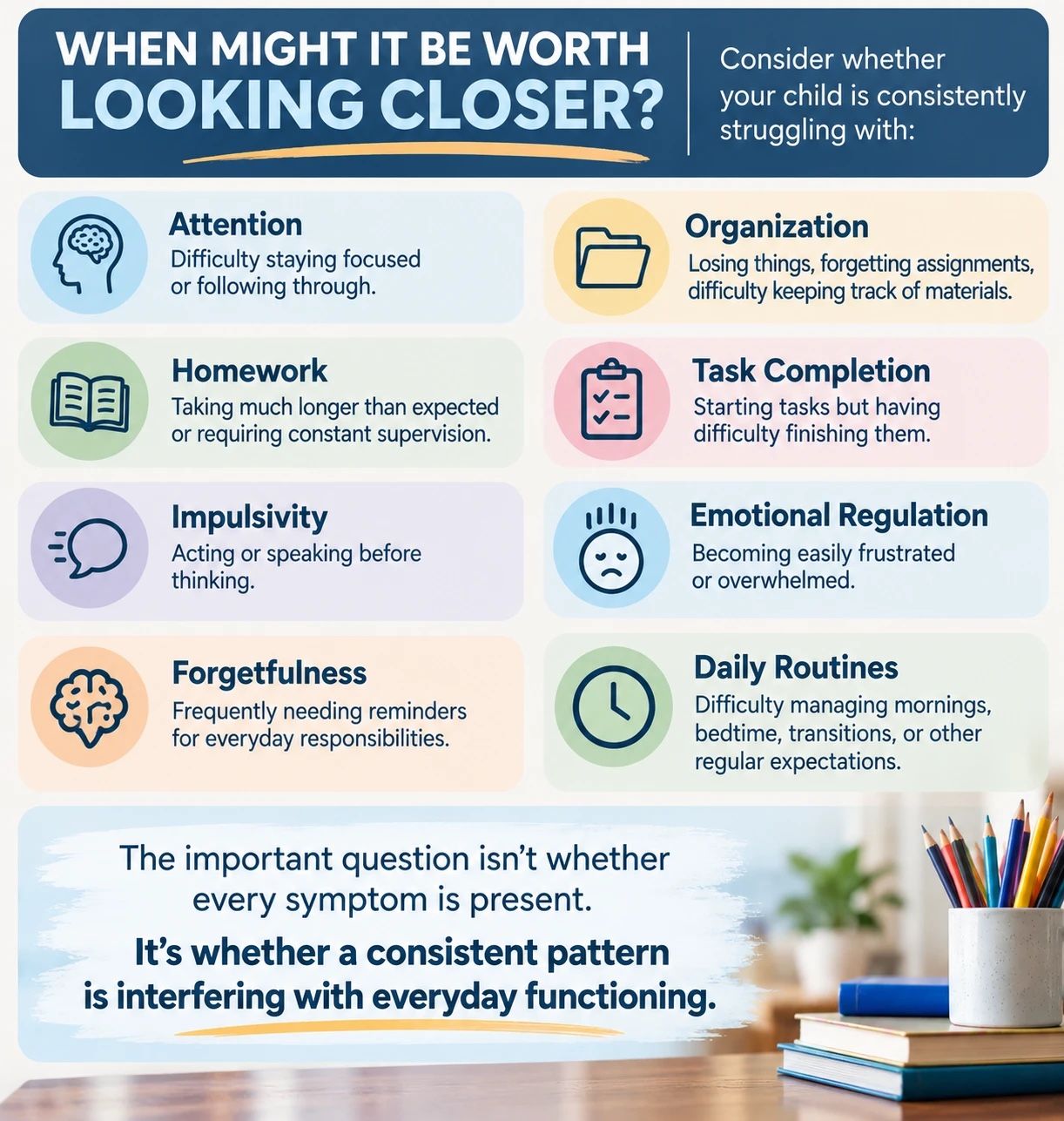
But you may want to look more closely when you consistently see problems with attention, organization, impulsivity, emotional regulation, homework, forgetfulness, task completion, or daily routines—especially when those difficulties are interfering with your child's functioning or creating significant stress for your child or family.
An evaluation does not have to end with an ADHD diagnosis.
Sometimes the most useful outcome is discovering that something else is contributing to the problem.
Either way, parents deserve more than, “The teacher doesn't see it, so everything must be fine.”
And teachers deserve more than, “The parent sees it, so it must be ADHD.”
The better question is: Why does this child function so differently in different environments, and what can we learn from that difference?
That question can lead us much closer to understanding what a child actually needs.
Need Help Understanding What Is Going On?
Student Evaluation Center provides comprehensive psychological and psychoeducational evaluations for children, adolescents, and adults in New Albany, Indiana. Evaluations may explore concerns related to ADHD, autism, learning disabilities such as dyslexia, executive functioning, emotional or behavioral concerns, and other difficulties affecting everyday functioning.
The purpose of an evaluation isn't simply to give someone a diagnosis. It is to better understand the person—their strengths, their difficulties, and what may help them move forward.
Resources
Centers for Disease Control and Prevention. Diagnosing ADHD. https://www.cdc.gov/adhd/diagnosis/
Centers for Disease Control and Prevention. Clinical Care of ADHD in Children. https://www.cdc.gov/adhd/hcp/clinical-care/
American Academy of Pediatrics. Clinical Practice Guideline for the Diagnosis, Evaluation, and Treatment of Attention-Deficit/Hyperactivity Disorder in Children and Adolescents. https://publications.aap.org/pediatrics/article/144/4/e20192528/81590/
This article provides general educational information and is not intended to diagnose ADHD or any other condition. Every child is different, and concerns about attention, behavior, or development should be considered in the context of the individual child.
© 2026 Student Evaluation Center, LLC