
Democrats Win Congress: What Could Change for Special Education and Your Child's IEP?

As Washington prepares for a new Congress, parents may be wondering whether changes in political leadership will affect their children's education.
Elections bring plenty of promises, predictions, and disagreements. But for parents of children with disabilities, the questions are often much more practical.
Will my child's school receive more funding? Will special education services improve? Will schools have enough teachers and support staff? And perhaps most importantly, will my child's educational rights change?
Following the November 2026 midterm elections, Democrats are preparing to take control of both chambers of Congress in January. That represents a significant change in Washington, but what does it actually mean for children receiving special education services?
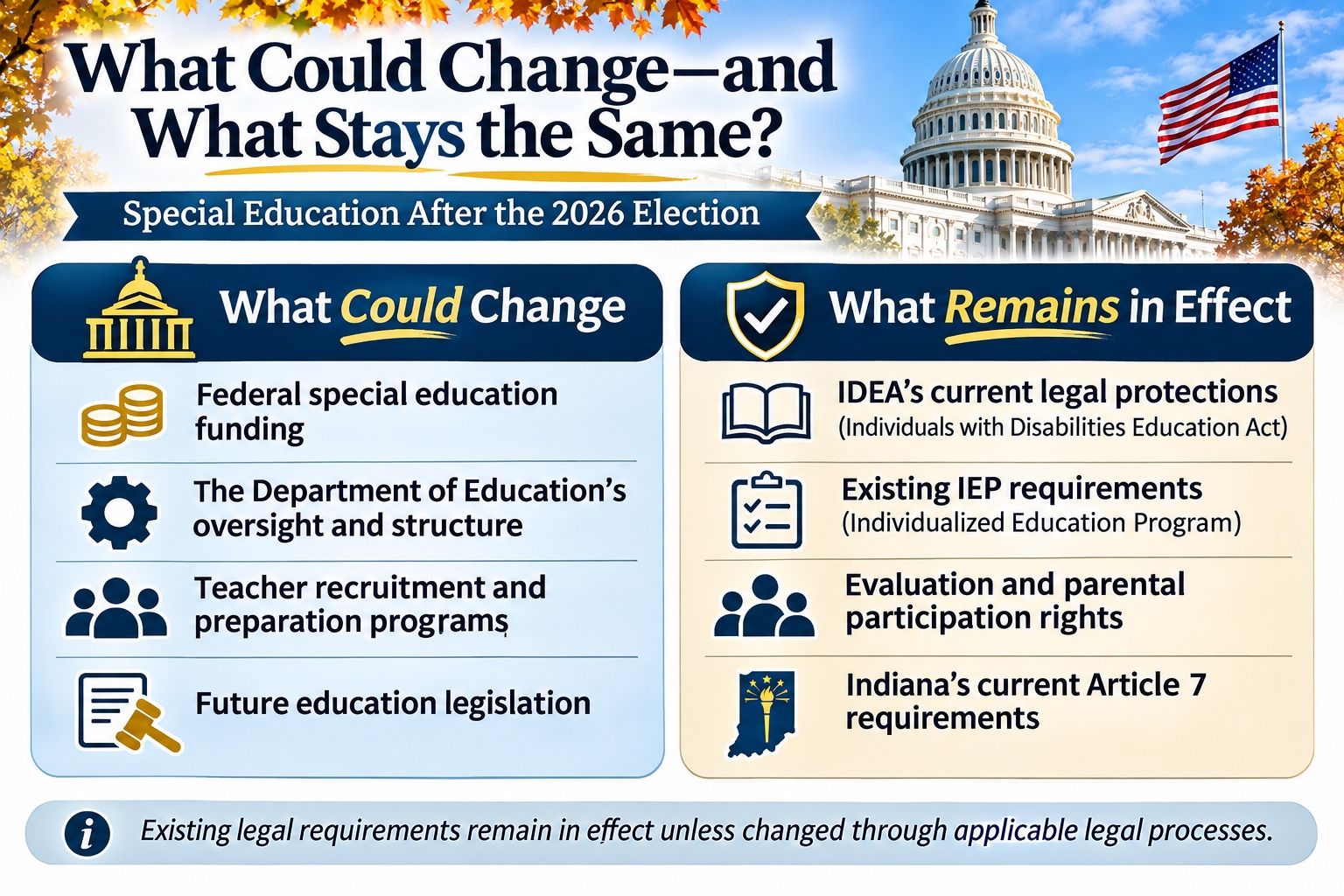
The answer is that some things could change, while others will remain the same unless new laws or policies are adopted.
1. Could Special Education Receive More Funding?
One of the most important questions involves funding for the Individuals with Disabilities Education Act (IDEA), the federal law that helps ensure eligible children with disabilities receive a free appropriate public education.
When IDEA was enacted, Congress established a federal funding formula that contemplated a substantial federal contribution toward the additional costs of special education. However, federal appropriations have historically fallen below the law's commonly cited 40% funding benchmark.
Congress has the authority to increase or decrease federal education appropriations, including funding that helps states and school districts provide special education services.
A new congressional majority may bring different budget priorities. However, increased funding is not automatic. Any new spending legislation must move through the legislative process, and negotiations with the president may affect the outcome.
For parents, the important question is not simply whether Congress approves more money. It is whether additional resources ultimately reach classrooms and improve the services children receive.
2. What Happens to the U.S. Department of Education?
The future of the U.S. Department of Education has been a major subject of national debate.
Some policymakers support reducing the federal government's role in education and giving states greater responsibility. Others believe strong federal oversight is necessary to ensure that children with disabilities receive consistent protections regardless of where they live.
Both perspectives raise questions worth considering.
States and local school districts already make most day-to-day educational decisions. At the same time, federal agencies play important roles in administering education funding, monitoring compliance, and enforcing civil rights protections.
A change in congressional leadership could influence proposals affecting the department's structure, responsibilities, and funding.
However, changing congressional leadership does not, by itself, eliminate or expand the department's authority. Significant changes may require legislation, administrative action, or court decisions.
For families, the most important consideration is whether the systems responsible for protecting children's educational rights remain accessible and effective.
3. Will My Child's IEP Rights Change?
This is probably the question I would most want parents to understand.
Your child's rights under IDEA do not disappear or automatically expand because one political party gains control of Congress.
Schools must continue to follow applicable federal and state special education laws.
For eligible students, those requirements include providing a free appropriate public education (FAPE), developing and implementing an appropriate Individualized Education Program (IEP), involving parents in educational decision-making, and following established evaluation and procedural safeguards.
A new Congress could propose changes to special education laws or the systems responsible for implementing them. But until those changes are legally adopted, existing requirements remain in place.
If your child's IEP calls for specialized instruction, related services, or other required supports, the school cannot simply disregard those obligations because of political uncertainty or changes in federal leadership.
4. Could This Help Address Special Education Teacher Shortages?

Anyone who has spent much time in schools knows that special education staffing can be challenging.
Some districts struggle to recruit and retain special education teachers, school psychologists, speech-language pathologists, and other qualified professionals. These shortages can place additional demands on existing employees and make it more difficult for schools to deliver services consistently.
Congress can influence this problem through funding for educator preparation, recruitment, training, and related initiatives.
But staffing shortages do not have a simple political solution.
Working conditions, compensation, caseloads, administrative demands, and the availability of qualified applicants all influence whether schools can attract and retain professionals.
Even if Congress provides additional funding, meaningful improvements may take time.
For parents, the issue is straightforward: A child's educational needs do not become less important because a school district is having difficulty hiring employees.
5. What Does This Mean for Indiana Families?
For families in Indiana, federal IDEA requirements operate alongside Indiana's special education regulations, commonly known as Article 7.
These rules address matters such as evaluations, eligibility, IEP development, educational services, and parental rights.
A change in congressional leadership does not automatically change Indiana's special education regulations.
Parents should continue participating in case conference committee meetings, reviewing their children's IEPs, monitoring educational progress, and communicating with schools when concerns arise.
If a child is struggling academically, behaviorally, socially, or emotionally, families should not feel they must wait for Washington to make decisions before seeking help.
Educational concerns deserve attention now.
6. What Should Parents Watch for in 2027?
Rather than focusing exclusively on political promises, I would encourage parents to pay attention to a few practical developments.
Will federal special education funding increase, decrease, or remain relatively unchanged? Will proposed changes to federal education agencies affect how parents seek assistance? Will Congress address shortages of qualified school personnel? And will any new legislation alter the protections currently provided under IDEA?
Those are the developments most likely to have meaningful implications for students and families.
It is also important to remember that federal policy changes do not always translate into immediate changes at the local school level. State decisions, district budgets, staffing, and implementation all play important roles.
The Bottom Line: Children Still Need Support Today
As a school psychologist, I've worked with families who are less concerned about political debates than about whether their child is learning, making progress, and receiving the support they need.
Those concerns are understandable.
A parent whose child cannot read at grade level wants effective instruction. A family whose child struggles with anxiety wants someone to recognize the problem. Parents of a student with autism want appropriate services and an educational environment where their child can succeed.
These needs do not change after an election.
A new Congress may create opportunities for different funding priorities, stronger oversight, or changes in federal education policy. Whether those opportunities lead to meaningful improvements remains to be seen.
Regardless of which political party controls Congress, children with disabilities deserve appropriate evaluations, effective educational services, and schools that take their needs seriously.
That should remain the focus of the conversation.
Supporting resources:
Disclaimer: This article is intended for general educational and informational purposes only and does not constitute legal advice. Education laws, regulations, and policies may change. Parents should consult their state's education agency or a qualified professional for guidance regarding their individual circumstances.
© 2026 Student Evaluation Center, LLC