
Can a School Tell You, “We Don’t Test for That”? What Indiana Parents Should Know
I have been hearing something from parents in my private practice that concerns me.
A parent approaches the school because their child is struggling. Maybe the child has significant difficulty reading. Maybe the parent suspects a learning disability or dyslexia. Maybe the concerns involve attention, impulsivity, organization, task completion, or other behaviors associated with ADHD.
The parent asks about testing.
And, according to some parents, the response is something along the lines of:
“We don't test for learning disabilities.”
Or:
“We don't do ADHD testing. You'll need to have that done privately.”
I have also heard another version:
“We don't have enough access to a school psychologist to do that testing. You'll need to get it done privately.”
Parents need to understand something very clearly:
That is not an adequate substitute for the special education evaluation process required under Indiana's Article 7.
There is an important distinction between a medical or clinical diagnosis and an educational evaluation. Schools are not medical clinics, and an Indiana public school does not necessarily provide the same type of diagnostic evaluation a parent might receive from a physician or private psychologist.
But that does not mean a school can simply send a parent somewhere else when there is reason to suspect that a child may have a disability and need special education services.
Although this article focuses on Indiana, many of the rights discussed here originate in federal special education law and apply to families throughout the United States.
This Is Not Just About ADHD or Learning Disabilities
ADHD and Specific Learning Disability are useful examples because they are two areas in which parents sometimes report being told to seek outside testing.
But the larger principle applies when any disability covered by Article 7 is suspected.
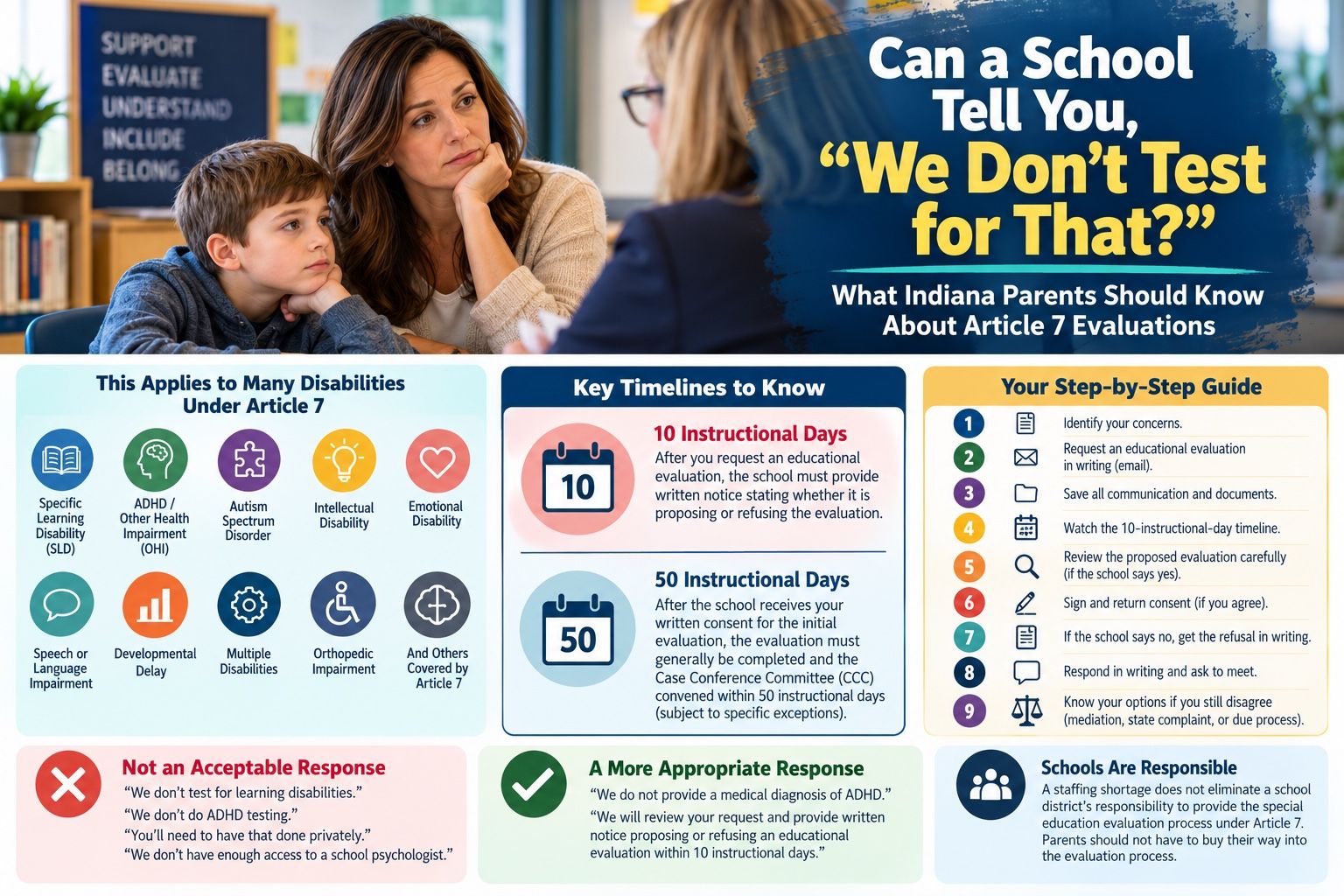
Article 7 addresses disability categories including Specific Learning Disability, Autism Spectrum Disorder, Other Health Impairment, Intellectual Disability, Emotional Disability, Speech or Language Impairment, Developmental Delay, and others.
The evaluations required for these disabilities are not all the same. A school may also need to obtain or consider outside medical information in certain situations.
But the evaluation process should begin with the child's suspected disability and educational needs—not simply with what a particular school says it “does” or “doesn't” test.
The fundamental question is:
Is there reason to suspect that this child may have a disability and may need special education and related services?
If so, Article 7 provides an evaluation process for answering that question.
Indiana Parents Have the Right to Request an Educational Evaluation
Indiana's special education regulations are commonly known as Article 7. They establish the procedures Indiana public schools must follow when determining whether a student has a disability and needs special education and related services.
Under 511 IAC 7-40-4, either the parent or the public agency may initiate a request for an educational evaluation.
Importantly, Article 7 says a parent's request may be made verbally or in writing to licensed school personnel.
Once that request is made, the school has 10 instructional days to provide the parent with written notice stating whether it is proposing or refusing to conduct the educational evaluation.
That distinction is important.
The school does not have to automatically say yes to every evaluation request.
But it does have to respond through the Article 7 process.
Put the Request in Writing Anyway
Although Article 7 permits a verbal request, I strongly recommend that parents make the request in writing—preferably by email.
There is a very practical reason for this:
You are creating a paper trail.
An email documents when you made the request. It documents what you requested. It identifies the concerns that led you to make the request. And it documents who received it.
The 10-instructional-day timeline does not begin because you used email; Article 7 also recognizes a verbal request. But an email makes it much easier to establish exactly when the request was made.
Save that email.
Save the school's response.
Save any consent forms you later sign.
If questions arise months later about when something happened, you will not have to rely on anyone's memory.
What About Specific Learning Disabilities?
Specific Learning Disability, or SLD, is one of the disability categories specifically addressed by Article 7.
Indiana's rules address learning difficulties involving areas such as reading, written expression, mathematics, oral expression, and listening comprehension.
Article 7 goes even further in certain SLD situations.
If a student is suspected of having a Specific Learning Disability because the student has not made adequate progress after an appropriate period of appropriate instruction, the public agency must initiate a request for an educational evaluation.
So “we don't test for learning disabilities” is not an adequate description of Indiana's special education evaluation process.
Schools absolutely have a role in evaluating students for suspected Specific Learning Disabilities.
The evaluation does not necessarily have to look like a private psychological or psychoeducational evaluation. Article 7 establishes requirements for an educational evaluation, and the multidisciplinary team determines what information is necessary to determine eligibility and the child's educational needs.
What About ADHD?
ADHD creates some confusion because there are really two different questions:
Does this child have ADHD?
And:
Does this child have a disability that makes the child eligible for special education under Article 7?
Those are not identical questions.
A physician, psychologist, or another qualified healthcare professional may conduct a clinical evaluation and diagnose ADHD.
A school is conducting an educational evaluation for a different purpose: determining whether the student meets Article 7 eligibility criteria and needs special education and related services.
But ADHD is not outside Article 7.
Article 7 specifically identifies attention deficit disorder and attention deficit hyperactivity disorder within the definition of Other Health Impairment (OHI).
So a school might appropriately say:
“We do not provide a medical diagnosis of ADHD.”
That can be true.
But that is very different from saying:
“We can't evaluate your child because you suspect ADHD. You'll need to pay for private testing first.”
If ADHD or another disability is suspected and there is reason to believe the condition may be adversely affecting the child's educational performance, the school must address whether an educational evaluation under Article 7 is appropriate.
What If the School Says, “We Don't Have Enough Access to a School Psychologist”?
This is another explanation some parents report hearing:
“Our school psychologist is only here one day a week.”
“We don't have enough school psychologists to do that testing.”
Or:
“You'll have to get private testing because we don't have someone available to do it.”
There is no question that shortages of school psychologists and other special education professionals are real. In some districts, school psychologists serve several buildings, manage very large caseloads, or have responsibility for students across an entire district.
Parents can certainly understand those challenges.
But a staffing problem does not eliminate a public agency's responsibilities under Article 7.
Article 7 places responsibility for the educational evaluation on the public agency, not on an individual school psychologist.
The multidisciplinary team reviews existing information, identifies the suspected disability or disabilities, determines what additional information is necessary, and gathers the information needed for the Case Conference Committee to make decisions about eligibility and educational needs.
A district is responsible for arranging the qualified personnel required under Article 7. For most suspected disabilities, that includes a school psychologist as part of the multidisciplinary evaluation team. Article 7 provides specific exceptions for certain developmental delay and speech or language evaluations.
When staffing is limited, the district must still determine how it will meet its evaluation responsibilities, which may include obtaining appropriately qualified contracted personnel.
What should not happen is for the district's staffing problem to simply become the parent's financial responsibility.
A personnel shortage may explain why a school is having difficulty completing evaluations. It does not, by itself, erase the school's obligation to follow Article 7.
There Is Another Important Timeline: 50 Instructional Days
Parents should actually be watching two different timelines during this process.
The first is the 10-instructional-day timeline after the parent requests an educational evaluation. During that period, the school must provide written notice proposing or refusing the evaluation.
If the school proposes the initial evaluation, the parent will be asked to provide written consent.
Once licensed school personnel receive written parental consent for an initial educational evaluation, Article 7 generally requires the evaluation to be completed and the Case Conference Committee convened within 50 instructional days.
Specific exceptions apply, including certain transfers between public agencies, repeated parental failure to make the student available for evaluation, and children transitioning from early intervention services. A general shortage of school psychologists is not among the listed exceptions.
That is another reason documentation matters.
Keep a copy of the signed consent and document the date it was received by the school.
Now you have documentation of both important dates:
Date 1: When you requested the evaluation.
Date 2: When the school received your written consent for the evaluation.
Schools Can Say No — But “No” Has a Process
This is an extremely important point.
A parent does not automatically get every evaluation or test requested simply because the parent asks for one.
A school can refuse to conduct an educational evaluation.
But Article 7 requires a process for doing so.
Within 10 instructional days after the parent's request, the school must provide written notice stating whether it proposes or refuses to conduct the educational evaluation.
If the school refuses, the written notice must explain the decision, including the evaluations, assessments, records, or reports relied upon and other relevant factors. Parents must also receive information about their procedural protections.
There is a significant difference between:
“We reviewed your request and the available information and are declining to conduct an educational evaluation for the following reasons...”
And:
“We don't test for that.”
The first is a decision made through the special education process.
The second is not an adequate substitute for that process.
What About Federal Law and Parents Outside Indiana?
Although this article focuses on Indiana's Article 7, the protections discussed here are not unique to Indiana.
The Individuals with Disabilities Education Act (IDEA) is the federal law that establishes special education requirements for public schools throughout the United States. Indiana's Article 7 provides the state regulations that implement these federal requirements and establish additional procedures.
Under IDEA, public schools have a responsibility commonly referred to as Child Find. This means schools must identify, locate, and evaluate children who may have disabilities and need special education and related services.
IDEA also gives parents the right to request an initial educational evaluation. When a school refuses to initiate an evaluation, federal regulations require prior written notice explaining the decision and the information supporting it.
These are federal protections, not simply Indiana requirements.
However, the specific procedures and timelines can vary by state.
For example, Indiana generally requires a written response to a parent's evaluation request within 10 instructional days and completion of an initial evaluation within 50 instructional days after written consent is received, subject to applicable exceptions.
Federal IDEA regulations generally establish a 60-calendar-day evaluation timeline after parental consent unless the state establishes its own timeframe. Other states may therefore have different requirements.
If you live outside Indiana, I encourage you to become familiar with your state's special education regulations. The following resources can help you get started:
U.S. Department of Education — IDEA — Information about federal special education law, regulations, and parental rights.
IDEA State Contacts — Information to help you locate your state's special education agency and resources.
IDEA Information for Parents and Families — Federal information and resources for families of children with disabilities.
Regardless of where you live, if you believe your child may have a disability and need special education, you can request an evaluation. I recommend making that request in writing, keeping copies of all communications, and learning the specific requirements that apply in your state.
Where Can Parents Outside Indiana Find Help?
If you live outside Indiana and your child's school has refused an evaluation, you do not have to figure everything out on your own.
Every state has organizations that help families understand special education rights, and many provide services at no cost.
A good place to begin is your state's federally supported Parent Training and Information Center. These centers can explain evaluation procedures, help you understand your rights, and guide you toward additional resources.
If you need more specialized assistance, the following national organizations can help you find support in your state:
Center for Parent Information and Resources — Find your state's parent center for help understanding evaluations, IEPs, and special education rights.
National Disability Rights Network — Locate your state's disability rights organization for advocacy, referrals, and possible legal assistance.
CADRE — Find state education agencies and parent centers, along with information about resolving special education disagreements.
Wrightslaw Yellow Pages for Kids — Search for special education advocates, attorneys, and other professionals in your state. Independently verify individual listings and qualifications.
Legal Services Corporation — Find local civil legal aid organizations if you need legal assistance and may qualify for free services. Special education assistance varies by organization.
Remember that IDEA provides federal protections, but each state has its own procedures and timelines. Knowing where to turn for reliable information can make a difficult situation much easier to navigate.
While the specific procedures may differ from state to state, the importance of documenting concerns, requesting evaluations in writing, and understanding your rights remains the same.
For Indiana families, the following steps provide a practical guide to navigating the evaluation process under Article 7.
A Step-by-Step Guide for Indiana Parents
If you believe your child may have a disability and may need special education services, here is a practical way to proceed.
Step 1: Write Down Your Concerns
You do not have to diagnose your child.
You don't need to know whether the correct category is SLD, OHI, Autism Spectrum Disorder, Emotional Disability, or something else.
Describe what you see.
For example:
My child is significantly behind in reading despite intervention.
My child has tremendous difficulty maintaining attention and completing assignments.
My child is struggling socially and I am concerned about autism.
My child's emotional or behavioral difficulties are interfering with school.
My child has difficulty understanding or using language.
My child continues to struggle academically despite receiving additional help.
Concrete examples are often more useful than diagnostic labels.
Step 2: Send a Written Evaluation Request
I recommend email because it automatically creates a dated record.
Send the request to licensed school personnel. Depending upon the circumstances, that might include the teacher, school psychologist, principal, counselor, or special education administrator.
Your request does not need to be complicated.
You can write:
I am formally requesting an educational evaluation under Indiana Article 7 to determine whether my child is eligible for special education and related services. I am concerned about [briefly describe your concerns]. Please consider this email my request for an educational evaluation and provide me with the written notice required under Article 7.
That's enough to make your intention clear.
Step 3: Save Everything
Create a folder.
It can be a physical folder or a folder on your computer.
Save:
Your original email requesting the evaluation
The school's response
Evaluation notices
Consent forms
Intervention records
Report cards
Relevant teacher emails
Medical or private evaluation records you choose to provide
Other important communications
You may never need that documentation.
But if a disagreement develops, you will be glad you have it.
Step 4: Watch the 10-Instructional-Day Timeline
The school has 10 instructional days to provide written notice proposing or refusing the educational evaluation.
Remember that these are instructional days—not simply calendar days.
Weekends, holidays, breaks, summer vacation, and other noninstructional days can affect the calculation.
Step 5: If the School Says Yes, Review What It Is Proposing
Read the proposed evaluation carefully.
Ask yourself:
Does this evaluation actually address the concerns I raised?
If reading is the concern, how will reading be evaluated?
If attention and executive functioning are major concerns, how will those concerns be assessed?
If autism is suspected, how will the evaluation examine social communication, behavior, development, and functioning across environments?
Parents do not need to dictate specific tests, but they should understand how the proposed evaluation will address the suspected areas of disability.
Ask questions if you don't understand.
Step 6: Sign and Return the Consent If You Agree
If you agree with the proposed initial evaluation and want it to proceed, provide written consent.
Then save a copy.
Document the date licensed school personnel received your written consent.
That is important because the 50-instructional-day evaluation timeline generally begins with receipt of that written consent.
When providing consent, I also recommend requesting a copy of the completed educational evaluation report before the Case Conference Committee meeting.
Under Article 7, parents who make this request are entitled to receive the report at no cost at least five instructional days before the scheduled CCC meeting.
Parents may also request a meeting to have the results explained before the CCC meets. The school must arrange that meeting within the five instructional days preceding the CCC meeting, at a mutually agreed upon time and place.
This gives families an opportunity to review the findings, prepare questions, and participate more meaningfully in eligibility discussions.
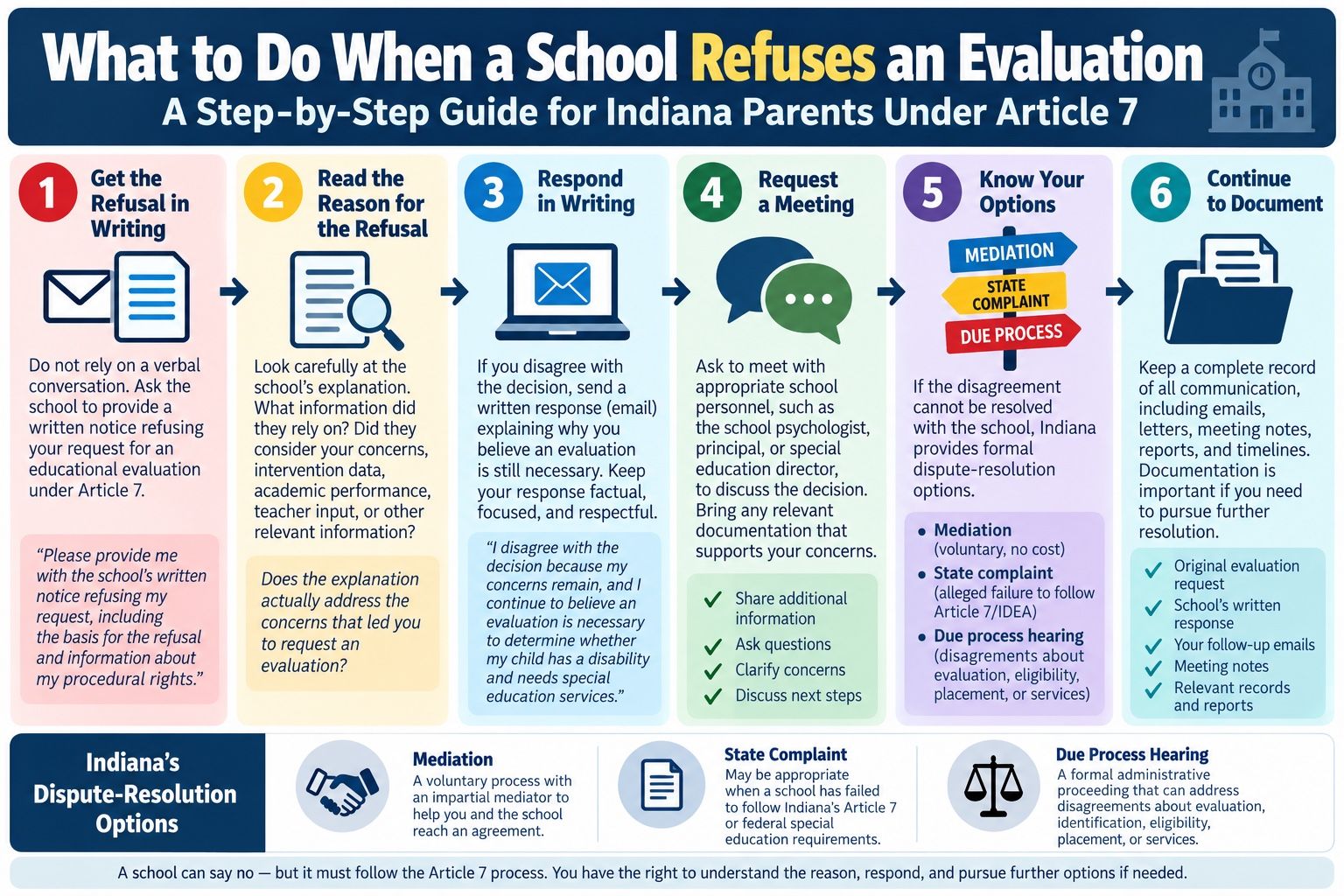
Step 7: If the School Says No, Get the Refusal in Writing
If someone tells you verbally:
“We're not going to evaluate.”
Or:
“We don't think testing is necessary.”
Or:
“We don't have a school psychologist available.”
Politely ask for the decision in writing.
You might respond:
Thank you. Please provide me with the school's written notice refusing my request for an educational evaluation, including the basis for the refusal and information regarding my procedural rights.
Do not rely solely on a telephone conversation, hallway conversation, or informal meeting.
Get the decision in writing.
Step 8: Read Why the School Said No
Don't focus only on the word no.
Look carefully at why the school refused.
What information did the school rely upon?
Did it consider the concerns you raised?
Did it review intervention data?
Did it consider academic performance, behavior, attendance, teacher information, previous evaluations, and other relevant information?
Does the explanation actually address the concerns that led you to request an evaluation?
Sometimes disagreements can be resolved because the school did not have all the relevant information or because the parent's concerns were misunderstood.
Step 9: Respond to the Refusal in Writing
If you disagree with the school's decision, say so.
Again, use email.
For example:
I received the school's written refusal of my request for an educational evaluation. I disagree with that decision because [briefly explain why]. My concerns regarding [reading/attention/behavior/social development/etc.] remain, and I continue to believe an evaluation is necessary to determine whether my child has a disability and needs special education and related services. I would like the school to reconsider this decision and would like to meet to discuss the information supporting the refusal.
Save that email too.
Step 10: Ask for a Meeting
If necessary, ask to meet with the appropriate school personnel.
That might include the school psychologist, principal, special education staff, or district special education director.
Bring your documentation.
Try to keep the discussion focused on one central question:
What evidence supports evaluating—or not evaluating—this child for a suspected disability?
That question helps move the conversation away from statements such as “we don't do that here” and back to the individual child's needs.
Step 11: Know Your Options If You Still Disagree
If you cannot resolve the disagreement with the school, Indiana provides formal dispute-resolution procedures.
Depending upon the nature of the disagreement, these can include:
Mediation — A voluntary process involving an impartial mediator to help the parent and school resolve a disagreement.
State complaint — A process that may be appropriate when a parent believes the school has failed to comply with requirements of Article 7 or federal special education law.
Due process hearing — A more formal administrative proceeding that can address disagreements involving identification, evaluation, eligibility, placement, services, or the provision of a free appropriate public education.
These options serve different purposes, so the appropriate next step depends upon what actually happened.
Parents do not necessarily have to exhaust informal meetings or reconsideration requests before pursuing formal dispute-resolution options. Depending on the circumstances, a parent may pursue mediation, a state complaint, or due process without first completing every informal step described above.
Parents can review the Indiana Department of Education's special education dispute-resolution information and procedural safeguards and may wish to consult a special education advocate or attorney when a significant dispute cannot be resolved.
Parents Should Not Have to Buy Their Way Into the Special Education Evaluation Process
This may be the most important point in this entire discussion.
Some families can afford a comprehensive private psychological or psychoeducational evaluation.
Many cannot.
A family's ability to spend hundreds or thousands of dollars on private testing should not determine whether concerns about a child's possible disability receive appropriate consideration by the public school.
Private evaluations can be extremely valuable. I conduct them regularly. They can provide families and schools with detailed information about a child's learning, attention, development, emotional functioning, strengths, and needs.
There are also times when parents choose a private evaluation because they want additional information, a clinical diagnosis, a second opinion, or a more comprehensive assessment than the school is proposing.
Those are perfectly reasonable reasons to seek private testing.
But that is very different from being told:
“You'll have to get private testing because we don't test for that.”
Or:
“You'll have to get private testing because we don't have enough access to a school psychologist.”
Private evaluations can supplement the educational process.
They should not become a financial gate that families must pass through before a public school will consider whether their child needs an educational evaluation.
The Bottom Line
Schools do not have to provide every clinical diagnosis that might be available from a private psychologist, physician, or other healthcare professional.
Schools do not have to administer every test a parent requests.
And requesting an evaluation does not mean a child will ultimately qualify for special education.
But when a parent suspects that a child may have a disability—whether the concern involves SLD, ADHD/OHI, autism, intellectual disability, emotional disability, speech or language difficulties, or another disability covered by Article 7—“we don't test for that” should not end the conversation.
Neither should:
“We don't have enough access to a school psychologist.”
Parents have the right to request an educational evaluation.
My advice is straightforward:
Make the request in writing.
Save the email.
Document the date.
Expect a written response within 10 instructional days.
If the school agrees to evaluate, save the signed consent and document when the school received it.
Request the evaluation report before the CCC meeting.
Then watch the applicable evaluation timeline.
And if the school says no, get that no in writing, understand the reasons for the refusal, respond in writing if you disagree, and know that Article 7 provides options for resolving the disagreement.
A parent should never walk away believing that the only way to have a suspected disability considered is to pull out a credit card and purchase a private evaluation.
That is not how Indiana's special education evaluation process is supposed to work.
Resources for Indiana Parents
Indiana Department of Education — Special Education Laws & Resources
Parents can access Article 7, Indiana's Procedural Safeguards Notice, Navigating the Course, and other special education resources through the Indiana Department of Education.
Indiana Article 7 — Initial Educational Evaluation Requests (511 IAC 7-40-4)
The regulation addressing parental evaluation requests, written notice, and parental consent.
Indiana Article 7 — Conducting Initial Educational Evaluations (511 IAC 7-40-5)
The regulation addressing the evaluation process, timelines, reports, and meetings.
Indiana Department of Education — Dispute Resolution
IDOE provides information about state complaints, mediation, due process hearings, and other options for resolving special education disagreements.
Indiana Department of Education — Office of Special Education
Parents who have general questions about Indiana's special education requirements can also contact IDOE's Office of Special Education.
Understanding Changes Everything™
Student Evaluation Center — Helping families better understand how children and adults learn, think, attend, and function.
Disclaimer: This article is provided for general educational and informational purposes only and is not intended as legal advice. Special education decisions depend on the individual circumstances of each student. Parents with questions about their specific situation should consult the Indiana Department of Education, a qualified special education advocate, or an attorney.
© 2026 Student Evaluation Center, LLC