
Did a Teacher Write Your Child's IEP—or Did Artificial Intelligence?
Artificial intelligence is changing how schools develop special education plans. But when a computer helps write your child's IEP, who is making sure the plan actually meets your child's needs?
Imagine sitting down at your child's annual Individualized Education Program (IEP) meeting. The special education teacher reviews the proposed goals, explains the accommodations, and discusses the services your child will receive over the coming year. The document looks professional, the language sounds appropriate, and everything appears to be in order.
But what if much of that document was written by artificial intelligence? And what if nobody told you?
Would you want to know?
More importantly, would it change how you felt about the recommendations being made for your child?
These are questions parents may need to start asking. Artificial intelligence, commonly called AI, is becoming increasingly common in schools. Teachers are using it to prepare lessons, develop instructional materials, and complete paperwork. Now, some special education teachers are using AI to help develop IEPs.
The question is not simply whether schools should use artificial intelligence. It is whether they can use it without losing sight of the individual child the IEP is supposed to serve.
More Teachers Are Using AI to Write IEPs Than You Might Think
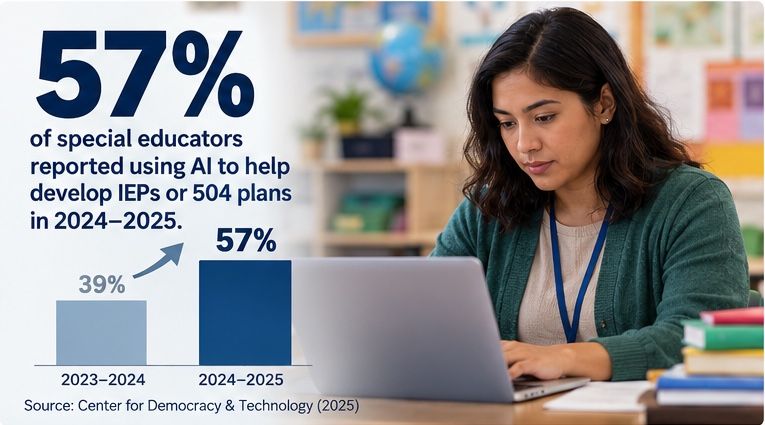
Research published by the Center for Democracy & Technology in 2025 found that 57% of surveyed licensed special educators reported using AI to help develop IEPs or Section 504 plans during the 2024–2025 school year. That was an increase from 39% the previous year.
Even more noteworthy, 15% reported using AI to write an IEP or 504 plan in full, compared with 8% the year before.
These findings do not mean that 57% of all IEPs are written by artificial intelligence. They reflect how the surveyed educators reported using AI, including assistance with both IEPs and 504 plans.
Nevertheless, the findings demonstrate how quickly this technology is entering special education.
And that raises an important question: Are schools developing policies and safeguards as quickly as teachers are adopting the technology?
For parents, this means that artificial intelligence may already be playing a role in their child's special education planning, even if nobody has discussed it with them.
Why Are Teachers Turning to Artificial Intelligence?
Before criticizing teachers for using AI, we should understand why they are using it.
Special education teachers have enormous responsibilities. In addition to providing instruction, they must monitor student progress, communicate with parents, participate in meetings, document services, and maintain detailed records required by federal and state laws.
For teachers managing large caseloads, the paperwork can become overwhelming.
Artificial intelligence offers an attractive solution. A teacher might enter information about a student's reading difficulties and ask an AI program to suggest measurable reading goals. Another teacher might use it to organize progress-monitoring data or explain complicated educational information in language parents can more easily understand.
Used appropriately, these tools could reduce paperwork and allow teachers to spend more time working directly with students.
That would certainly be a positive development.
The concern begins when technology moves beyond assisting the teacher and starts replacing the professional judgment that should guide educational decisions.
There is a meaningful difference between using AI to help write a document and allowing AI to decide what belongs in that document.
An IEP Is Supposed to Be Individualized. What Happens When AI Gets It Wrong?
The first word in Individualized Education Program is there for a reason.
An IEP is not supposed to be a collection of standard goals, commonly used accommodations, or recommendations that happen to sound appropriate for a particular disability.
It is supposed to reflect the unique educational needs of one child.
Consider two fourth-grade students who have both been identified with a Specific Learning Disability in reading.
The first child struggles primarily with decoding unfamiliar words. Reading is slow and effortful, but listening comprehension and oral language abilities are well developed.
The second child reads individual words accurately but has difficulty understanding and remembering what has been read.
Both children may have the same disability classification, but their instructional needs are quite different.
The first child may need systematic instruction targeting word-reading skills and fluency. The second may require instruction in reading comprehension, vocabulary, and strategies for understanding text.
An AI program that receives only the information that a student has a reading disability might generate similar goals for both children.
Those goals might sound reasonable. They might even be measurable and professionally written.
But they could miss the most important part of the evaluation: understanding why each child is struggling.
This is where professional judgment becomes essential.
A school psychologist, special education teacher, or other qualified professional must interpret evaluation findings, understand how the child's difficulties affect classroom performance, and help identify appropriate educational needs.
Artificial intelligence can make an IEP sound individualized. Only careful evaluation, professional judgment, and meaningful collaboration with parents can ensure that it truly is.
AI can organize information and suggest possibilities. It cannot independently establish that a recommendation is appropriate for a particular student.
And a well-written IEP is not necessarily an effective IEP.
What Does Federal Special Education Law Say About AI?
The Individuals with Disabilities Education Act (IDEA) establishes requirements for developing, reviewing, and revising IEPs.
Under federal regulations, the IEP team must consider the child's strengths, parents' concerns, evaluation results, and academic, developmental, and functional needs.
The IEP must also include measurable annual goals, appropriate educational services, and other required information.
These requirements are found in 34 CFR §§ 300.320 and 300.324.
Here is the important distinction.
Federal special education law does not categorically prohibit teachers from using artificial intelligence to help draft an IEP.
However, using AI does not eliminate any of the school's responsibilities under IDEA.
The IEP must still be developed through the legally required team process. Parents must have meaningful opportunities to participate, and the plan must address the child's individual educational needs.
A computer-generated recommendation does not become appropriate simply because it appears in an IEP.
The law requires an individualized educational program, not simply an individualized-looking document.
For Indiana families, these federal protections work alongside Indiana's special education regulations, commonly known as Article 7. Whether a school uses artificial intelligence or traditional methods to prepare an IEP, the educational team remains responsible for developing a plan that addresses the student's individual needs and complies with applicable federal and state requirements.
What About Your Child's Privacy?
There is another concern that deserves just as much attention.
An IEP may contain some of the most sensitive information a school maintains about a child.
It can include psychological evaluation findings, disability classifications, behavioral concerns, academic weaknesses, medical information, and descriptions of emotional or social difficulties.
Now imagine a teacher copying portions of a child's psychological evaluation into an AI program and asking it to summarize the findings.
Where does that information go?
Is it stored by the company providing the AI service? Could it be retained or used to improve the company's systems? Who might have access to it?
The answers depend on the particular technology, its privacy settings, and the agreements governing its use.
Some AI systems are specifically designed for educational settings and include contractual privacy protections. Others may not provide the safeguards necessary for handling identifiable student information.
The Family Educational Rights and Privacy Act (FERPA) protects personally identifiable information contained in students' education records. Schools must comply with applicable FERPA requirements when disclosing protected information to outside technology providers.
Certain disclosures may be permitted without parental consent when specific legal requirements are satisfied. However, using an AI program does not automatically make a disclosure permissible.
Parents should be able to ask whether their child's identifiable educational information is being entered into AI systems and what safeguards are in place.
This is not about resisting technology. It is about protecting children.
Should Parents Be Told When AI Helps Write an IEP?
This may be the most controversial question of all.
Suppose a teacher uses AI to improve the wording of a goal that the IEP team has already determined is appropriate.
Should the teacher be required to disclose that?
What if AI suggests the goal itself?
What if an entire proposed IEP is generated using artificial intelligence and then reviewed by school personnel?
At what point does the technology become important enough that parents deserve to know about its involvement?
There is no single nationwide IDEA requirement that schools disclose every instance of AI-assisted IEP drafting. State laws, district policies, and particular uses of student information may create additional obligations.
Nevertheless, I believe transparency is an important part of maintaining trust between schools and families.
Parents are expected to participate meaningfully in decisions about their child's education. That participation becomes more difficult when they do not understand how proposed goals and recommendations were developed.
This does not mean that every use of technology needs to become a legal issue.
But when AI is used to suggest educational goals, interpret student information, or recommend services, parents have a reasonable interest in understanding how those suggestions were evaluated.
The goal should not be to create suspicion between parents and teachers. It should be to ensure that everyone understands who is responsible for the educational decisions being made.
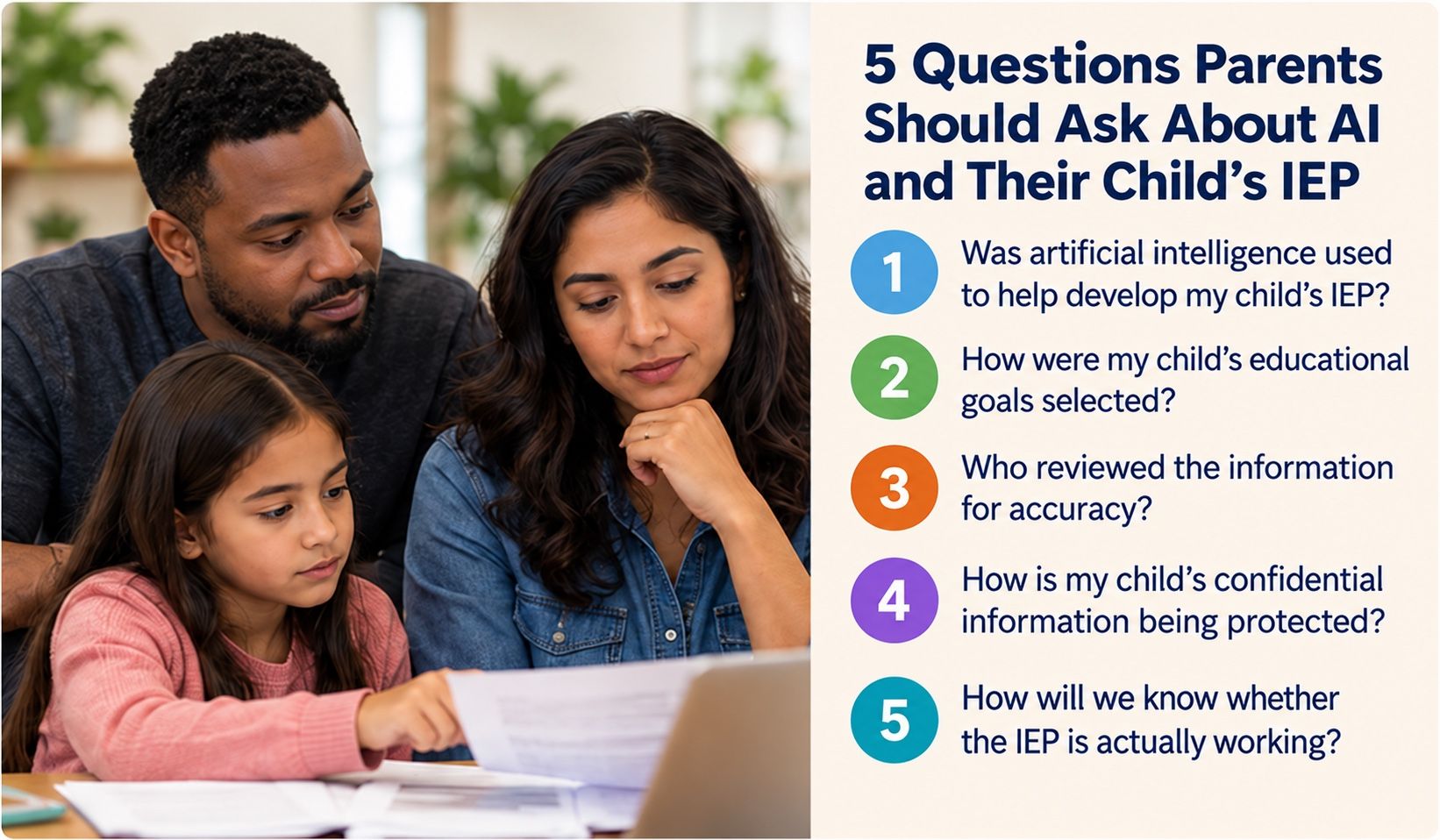
Five Questions Parents Should Ask About AI and Their Child's IEP
Parents do not need to become technology experts to protect their child's educational interests. They do, however, need to remain active participants in the IEP process.
If your child receives special education services, consider asking these questions at the next IEP meeting.
1. Was artificial intelligence used to help develop my child's IEP?
This is a reasonable question. The answer may help you understand whether AI was used simply to improve the wording or played a larger role in developing goals and recommendations.
2. How were my child's educational goals selected?
Ask the team to explain how each important goal relates to your child's current performance, evaluation findings, and classroom needs. A meaningful goal should address an identified need, not merely sound appropriate for a particular disability.
3. Who reviewed the information for accuracy?
If AI helped draft portions of the IEP, ask who verified that the information was correct. School personnel should be able to explain the recommendations and educational goals without relying on a computer-generated document.
4. How is my child's confidential information being protected?
Ask whether personally identifiable information from evaluations, educational records, or IEP documents is entered into AI programs. If so, ask what safeguards are in place.
5. How will we know whether the IEP is actually working?
This may be the most important question of all. Ask how progress will be measured, how often it will be reviewed, and what the team will do if your child is not making expected progress.
A beautifully written IEP accomplishes very little if it does not lead to appropriate instruction and meaningful educational progress.
Could Artificial Intelligence Actually Improve Special Education?
Absolutely. And that possibility should not be overlooked.
Artificial intelligence may help educators organize information, identify patterns in student progress, develop clearer explanations for parents, and reduce time spent on repetitive paperwork.
Early research examining AI-assisted IEP development suggests that carefully supervised use may improve some aspects of written educational goals. However, important questions remain about accuracy, individualization, privacy, and implementation.
A teacher who spends less time completing paperwork may have more time to provide instruction and monitor student progress.
A school psychologist who can organize evaluation information more efficiently may have more time to interpret findings, consult with teachers, and help families understand their child's needs.
Those are worthwhile goals.
But technology should support the professional's work, not replace the professional's responsibility.
A Final Thought for Parents
If you discover that artificial intelligence helped develop your child's IEP, there is no reason to assume that something improper has occurred.
The technology may have been used appropriately, and the resulting document may accurately reflect your child's needs.
But you should feel comfortable asking how the plan was developed, who reviewed the recommendations, and how the team determined that the goals and services were appropriate.
Those are reasonable questions whether artificial intelligence was involved or not.
After all, the purpose of an IEP is not to produce a document. It is to provide an educational plan that helps a child learn, develop, and make meaningful progress.
Technology may change how that document is written. It should never change the responsibility to understand the child behind it.
Your child deserves more than a well-written IEP. Your child deserves an IEP that is genuinely individualized, thoughtfully developed, and effectively implemented.
And no computer should ever change that.
Resources and Further Reading
1. Center for Democracy & Technology (2025)
From Personalized to Programmed: The Use of Generative AI to Develop Individualized Education Programs for Students with Disabilities.
2. U.S. Department of Education — IDEA
34 CFR § 300.320: Definition of Individualized Education Program.
Read the Federal IEP Requirements
3. U.S. Department of Education — IDEA
34 CFR § 300.324: Development, Review, and Revision of IEPs.
Read the IEP Development Requirements
4. Coleman, O. F., & Waterfield, D. A. (2026)
Ethical AI Use in IEP Development: A Guiding Framework.
5. Waterfield, D. A., et al. (2026)
IEPs in the Age of AI: Examining IEP Goals Written With and Without ChatGPT.
Read the Research Article (ERIC)
About Student Evaluation Center
If you have questions about whether your child's IEP accurately reflects their learning, attention, developmental, or emotional needs, an independent psychoeducational evaluation may help clarify their strengths, challenges, and educational needs.
Student Evaluation Center provides independent psychological and psychoeducational evaluations for children, adolescents, and adults. Evaluations are designed to help families better understand learning, attention, developmental, emotional, and behavioral concerns.
Our goal is to provide clear, individualized information that helps families make informed decisions about educational and psychological needs.
To learn more or schedule a free 30-minute consultation, visit Student Evaluation Center.
Disclaimer: This article is provided for educational and informational purposes and does not constitute legal advice. Federal and state special education requirements, district policies, and student privacy protections may vary. Parents with questions about their child's IEP should consult their child's educational team or an appropriate special education advocacy resource.
© 2026 Student Evaluation Center, LLC